

How to Finance Vocational Trucks: Approval Rules for Dump, Refuse, and Tow Trucks
Financing Class 7 and 8 vocational trucks (dump, tow, and refuse equipment) requires specialized underwriting because traditional banks rely on rigid FICO scores that fail to account for PTO (Power Take-Off) hours, custom body equipment, and contract-backed revenue.
Key Market & Underwriting Insights
- Market Opportunity: The global vocational truck market is expanding from $117.7 billion to over $200 billion, driving record demand for commercial equipment loans.
- The Traditional Lender Gap: Generic banks misprice vocational assets because they evaluate standard chassis depreciation rather than specialized body value, hydraulic hours, and seasonal cash flows.
- The Direct Lending Advantage: Specialized commercial lenders underwrite using real operational metrics, such as Debt Service Coverage Ratio (DSCR), municipal contracts, and dispatch logs, delivering 24- 48-hour approvals for owner-operators and fleets.
Here is an insider look at the credit, cash flow, equipment, and contract requirements needed to secure fast, flexible commercial truck financing.
The Core Underwriting Rules for Vocational Truck Financing
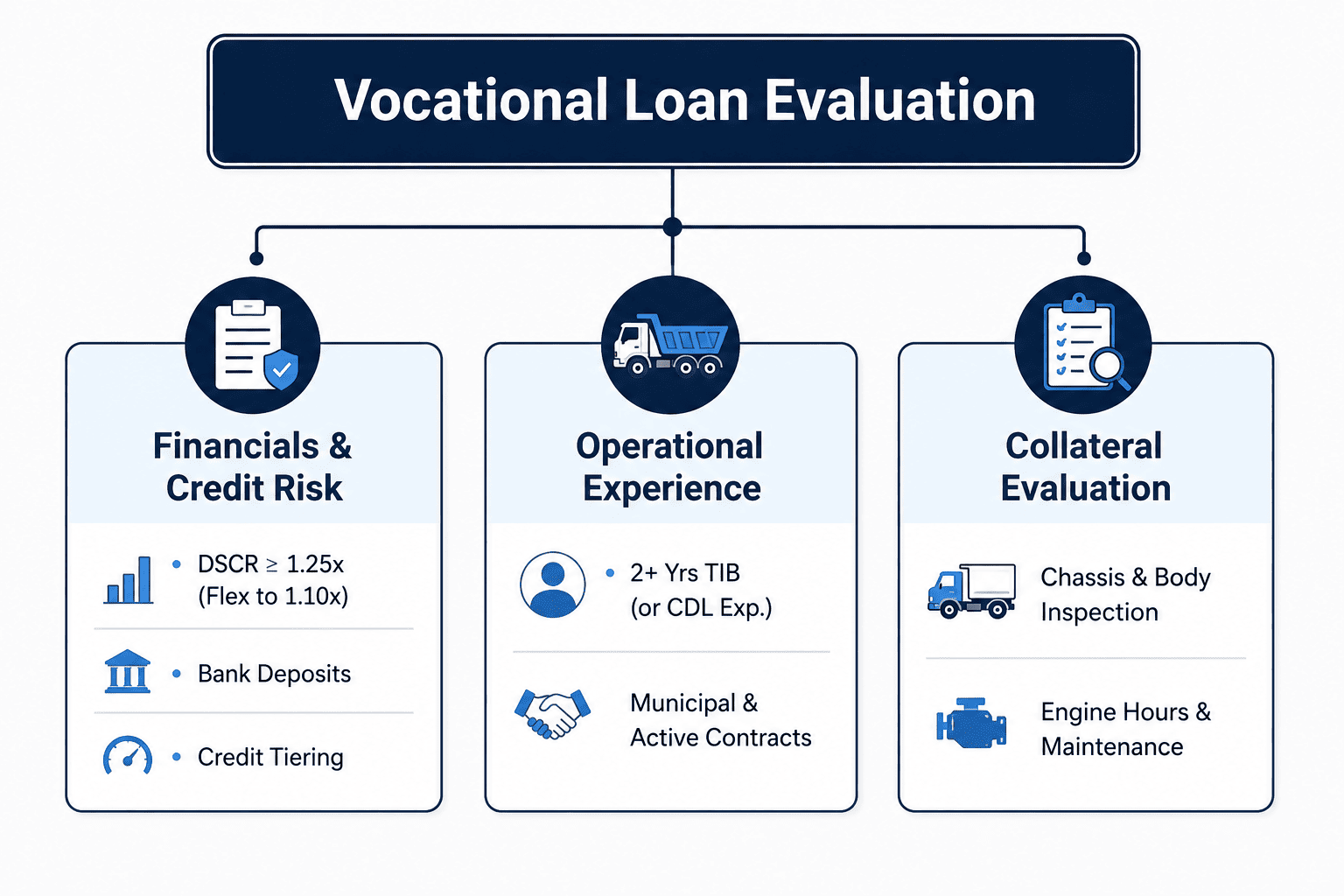
Commercial underwriters evaluate vocational requests using a balance of financial health, industry experience, and collateral quality. Knowing these metrics before submitting an application prevents surprises and speeds up your funding timeline.
Credit Profile vs. Operational Revenue
While a high credit score unlocks the lowest interest rates and minimal down payments, a less-than-perfect score will not automatically disqualify you. Direct commercial lenders evaluate overall operational cash flow alongside credit history:
- Prime (700+ FICO): Unlocks 0%–10% down payment options, competitive interest rates, and minimal document requirements.
- Near-Prime (600–699 FICO): Standard 10%–20% down payments; requires 3 to 6 months of recent business bank statements to demonstrate debt service ability.
- Subprime (<600 FICO or Limited History): Requires proof of consistent monthly bank deposits, active work orders, or strong collateral equity. Program structures like bad credit truck financing prioritize real revenue over historical credit hiccups.
Debt Service Coverage Ratio (DSCR)
Lenders use the Debt Service Coverage Ratio (DSCR) to verify that your business generates enough net operating income to comfortably cover loan payments:
$$\text{DSCR} = \frac{\text{Net Operating Income}}{\text{Total Debt Payments}}$$
- Standard Benchmark: Institutional lenders generally look for a 1.25x DSCR, meaning your business generates $1.25 in net income for every $1.00 of total debt obligations.
- Vocational Flexibility: Specialized direct lenders can approve deals with a 1.10x–1.15x DSCR when backed by verified route contracts, municipal subcontracts, or strong seasonal reserves.
Time in Business (TIB) and Operator History
- Established Businesses (2+ Years): Full access to expanded fleet credit lines, streamlined application-only limits (often up to $250,000+ without full tax returns), and reduced down payments.
- Startups & New Owner-Operators (<2 Years): Requires proof of relevant industry background, such as a Class A/B CDL history, prior management experience in construction or towing, or guaranteed haul agreements.
Down Payment Structure
Down payment tiers reflect the overall risk profile of the transaction:
- 0%–10% Down: Prime credit, repeat clients, or brand-new dealership equipment.
- 10%–20% Down: Standard benchmark for quality used vocational units purchased through recognized dealers.
- 25%–30% Down: Required for older equipment, private-party sales, or credit-challenged applicants to establish skin in the game.
Equipment Age, Chassis, and Hours
Unlike standard long-haul tractors that accumulate high highway mileage quickly, vocational trucks accumulate wear through engine operating hours powering hydraulic systems, booms, and packers. Underwriters evaluate:
- Overall chassis mileage versus total PTO/engine hours.
- Vehicle condition and maintenance logs.
- Equipment age (typically capping standard terms at 10-12 years old, though exceptions exist for high-value body build-outs like heavy rotators or concrete boom pumps).
Comparative Approval Matrix by Vocational Vehicle Type
Different vocational applications carry distinct operational risk profiles. The table below outlines how underwriting expectations shift across the primary vocational categories:
Underwriting Metric | Dump Trucks | Refuse / Garbage Trucks | Tow & Recovery Vehicles |
Primary Approval Driver | Construction contracts, gravel/asphalt haul agreements | Municipal contracts, commercial subscription routes | Dispatch logs, motor club volume, police rotation contracts |
Typical Down Payment | 10% – 20% | 10% – 20% | 10% – 25% |
Key Inspection Target | Hydraulic hoist, bed liner, frame rail structural integrity | Packer mechanism, hydraulic pumps, floor/body rust | Boom/wheel-lift rating, PTO assembly, winch cables |
Revenue Stability | Moderate to High (Seasonal fluctuations in northern climates) | High (Consistent, recession-resilient year-round revenue) | Moderate to High (Spikes during severe weather & emergency calls) |
Common Licensing Need | Class A or B CDL (Depending on GVWR & payload) | Class B CDL | Non-CDL (Light/Medium Flatbeds) to Class A (Heavy Rotators) |
Specific Approval Rules by Vehicle Type
Dump Truck Financing Approval Rules
Dump trucks are the backbone of site development, paving, and infrastructure projects. Because construction activity can be seasonal, underwriters evaluating dump truck financing pay close attention to cash flow management during winter months.
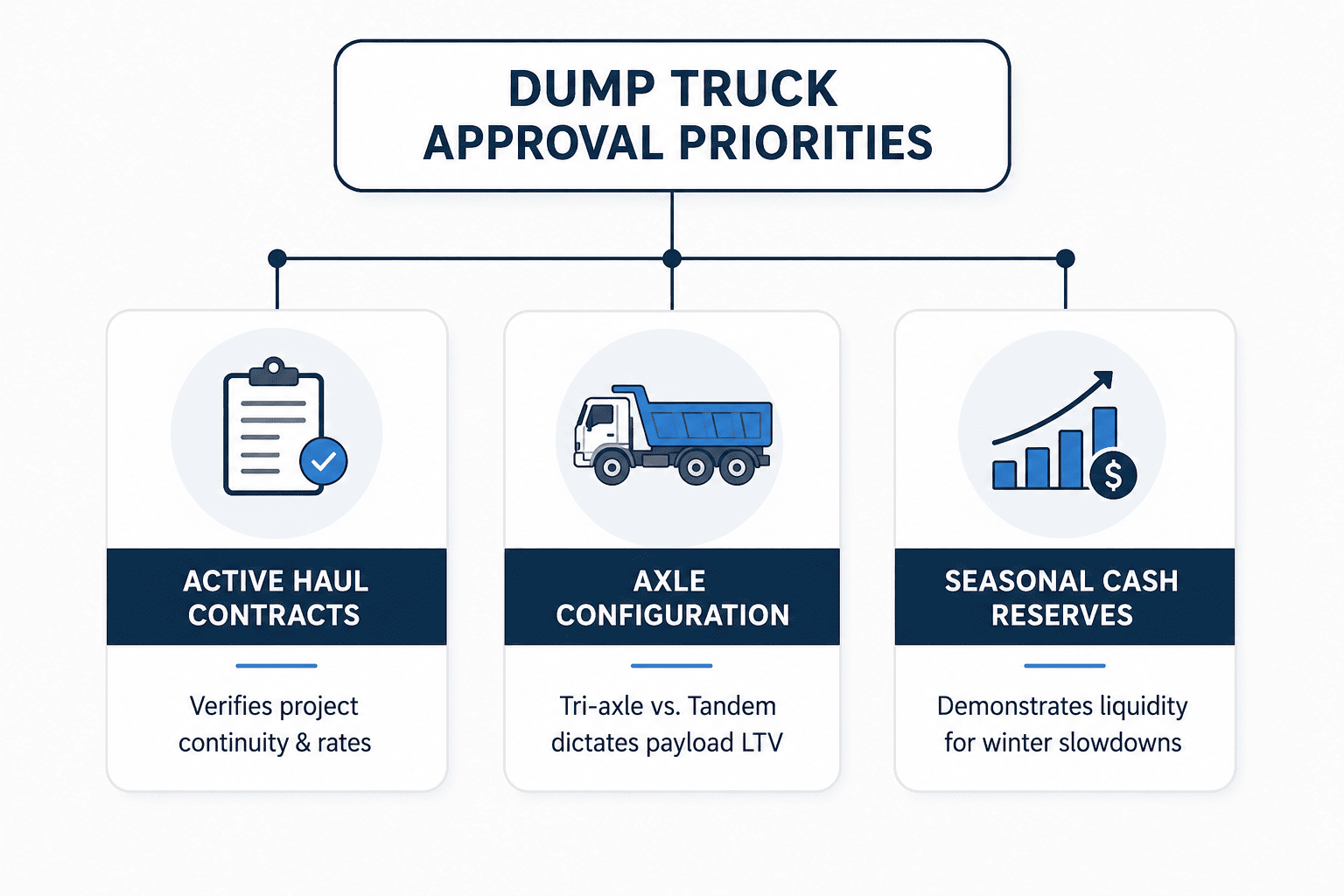
- Contract Validation: Showing active contracts with general contractors, quarries, or municipalities strengthens your application and can lower required down payments.
- Axle Configuration & GVWR: Tri-axle and quad-axle units command higher resale value and higher loan-to-value (LTV) thresholds compared to single-axle single-dump units because of their higher legal payload capacities.
- Seasonal Payment Structuring: Tailored financing programs offer custom payment structures that align lower monthly obligations with off-peak seasonal months, ensuring your cash reserves stay intact year-round.
“Expert Tip: When applying for used dump truck funding, provide a recent oil analysis and hydraulic cylinder inspection. Proving proper hoist maintenance reassures underwriters that the unit will not experience sudden operational downtime.”
Refuse & Garbage Truck Financing Approval Rules
Refuse collection, whether residential, commercial, or roll-off container services, is considered one of the most stable segments in commercial transportation.
- Municipal & Commercial Route Validation: Long-term residential collection contracts or documented subscription routes provide guaranteed cash flow, making these approvals straightforward even for growing fleets.
- Packer Body Wear Assessment: Used garbage trucks face severe environmental and physical stress. Underwriters inspect hydraulic pump pressure ratings, floor thickness in rear/side loaders, and packer blade mechanics.
- Environmental & Maintenance Logs: Complete maintenance records showing regular hydraulic fluid flushes and chassis grease cycles help secure extended repayment terms on pre-owned equipment.
Tow Truck & Recovery Vehicle Approval Rules
From light-duty flatbeds handling roadside assistance to 75-ton rotators executing complex highway recoveries, towing businesses operate on speed and availability, making fast tow truck financing critical to keeping your recovery fleet road-ready 24/7.
- Dispatch & Management Software Logs: Lenders examine dispatch logs (such as Towbook or Beacon reports) to verify daily call volume, average ticket amounts, and revenue consistency.
- Police Rotation & Municipal Contracts: Being listed on state or local police rotation rosters demonstrates steady emergency call volume, serving as a strong compensating factor for near-prime credit applicants.
- CDL vs. Non CDL Equipment Limits: Non-CDL Flatbeds (under 26,000 lbs GVWR): Lower barriers to entry; ideal for startup operators. Heavy-Duty Wreckers & Rotators: Require experienced drivers with Class A CDLs and specialized recovery training certificates to satisfy both underwriting and insurance requirements.
Three Common Red Flags That Delay Approval (And How to Fix Them)
Red Flag | Strategic Fix |
1. Mixing Personal & Business Funds in Primary Bank Accounts | Maintain dedicated business bank accounts showing 3+ months of clear commercial revenue deposits. |
2. Private Seller Purchases Without Pre-Approval or Inspection | Secure soft-pull pre-qualification first; obtain complete vehicle specs, VIN verification, and a copy of the seller’s title. |
3. Mismatched Operator Licensing for Heavy-Duty Class 8 Units | Ensure drivers hold the proper Class A/B CDL credentials before submitting loan documents. |
The Fast 3-Step Approval Process (24-48 Hours)
Securing funding for your vocational fleet should not involve weeks of red tape. At Lewis Capital, we streamline commercial equipment financing so you can take delivery of your truck quickly.
Step 1: Soft-Pull Pre-Qualification
Complete a quick single-page application. Our initial pre-qualification uses a soft credit check that does not impact your personal credit score.
Step 2: Document Submission & Review
Provide basic equipment specifications (invoice or spec sheet), driver’s license, and 3 to 6 months of business bank statements. Our team evaluates your real operational cash flow rather than judging you solely on a credit score.
Step 3: Custom Term Selection & Direct Funding
Select repayment terms structured around your seasonal revenue cycles. Once finalized, funds are issued directly to the dealer or seller in as little as 24 to 48 hours.
Expand Your Vocational Fleet with Confidence
Financing a vocational truck requires a partner who understands the transportation industry. Whether you are adding a dump truck for paving season, expanding a municipal refuse route, or upgrading your recovery fleet with a heavy wrecker, your approval hinges on cash flow, equipment quality, and working with the right lender.
With over 25 years of commercial lending expertise, Lewis Capital provides direct, transparent financing tailored to your business goals.
Ready to Get Your Fleet on the Road?
- Fast Approvals: Credit decisions in 24-48 hours.
- No Credit Risk: Pre-qualify using a soft credit pull with zero FICO score impact.
- Flexible Options: Solutions available for owner-operators, expanding fleets, and all credit profiles.
Frequently Asked Questions
What credit score is needed to finance a vocational truck?
Most commercial lenders look for a credit score of 600 or higher for standard terms. However, direct lenders can approve scores under 600 through bad credit truck financing by evaluating monthly bank deposits, active hauling contracts, and overall business cash flow.
How much down payment is required for dump or tow trucks?
Down payments typically range from 10% to 20% for pre-owned equipment. Prime borrowers (700+ FICO) may qualify for 0% to 10% down, while startups or subprime applicants generally require 20% to 30% down to reduce lender risk.
Can a startup towing or hauling company get equipment financing?
Yes. Startups with less than 2 years in business can qualify by providing proof of prior CDL driving experience, active dispatch logs, or guaranteed municipal and motor club contracts as proof of future revenue.
Can I finance a used vocational truck with high engine hours?
Yes. Lenders routinely finance units up to 10-12 years old. Because specialized body equipment (like heavy rotators, dump beds, and packers) retains strong collateral value, underwriters focus on maintenance logs and PTO/engine hours rather than chassis mileage alone.
How fast can a commercial truck loan get approved and funded?
Pre-qualification takes 24 to 48 hours via a soft credit check. Once bank statements and vehicle specification sheets are submitted, funds can be disbursed directly to the dealer or private seller within 1 to 2 business days.