
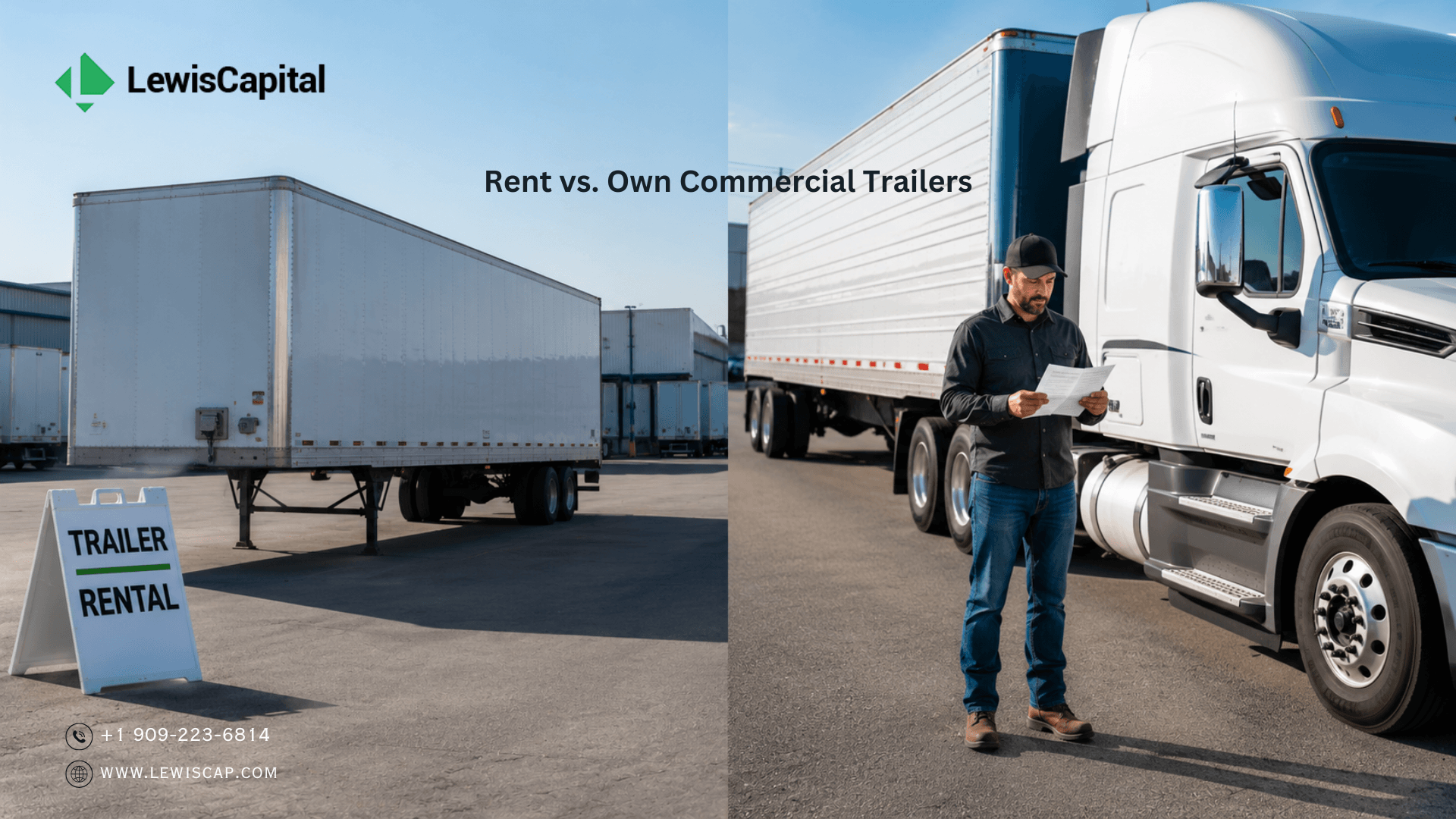
Rent vs. Own Commercial Trailers: Which Option Makes More Sense for Your Business?
For transportation companies, logistics operators, and owner-operators, few challenges are as constant as capacity management. Fleet directors face pressure to scale up to capture new contracts, but scaling too quickly can tie up precious capital in depreciating equipment.
When you need to add trailers to your fleet, you face a critical crossroads: Should you rent short-term, or does the classic rent vs own trailer debate lean heavily toward ownership?
While short-term rentals offer rapid flexibility, outright purchasing isn’t your only alternative. Flexible commercial trailer financing and leasing structures allow you to capture the benefits of ownership without draining your cash reserves.
Let’s break down the operational, financial, and tax realities of renting versus owning so you can make the right strategic move for your business.
The Financial Blueprint: OpEx vs. CapEx
The choice between renting and owning affects your balance sheet and your cash flow month to month. Understanding the difference between Operating Expenses (OpEx) and Capital Expenses (CapEx) is key.
Feature | RENTING (OpEx) | FINANCING/OWNING |
Upfront Cash | Low initial deposit | Flexible down payment |
Balance Sheet | Off-balance sheet | Adds a tangible asset |
Tax Treatment | Direct deduction | Sec. 179 write-off |
Long-term Value | Zero equity built | Asset has resale |
Renting as an Operating Expense (OpEx)
When you rent a commercial trailer for the short term, the expense is categorized under OpEx.
- Preserving Capital: Rental agreements typically require minimal upfront cash, keeping your working capital free for immediate needs like fuel, driver pay, and insurance.
- Immediate Tax Deductions: Rental payments are usually fully deductible in the fiscal year they are paid, making tax tracking simple.
- Off-Balance Sheet Flexibility: Because you don’t own the asset, short-term rental liabilities don’t weigh down your debt-to-equity ratio, keeping your traditional lines of credit clear.
Owning & Financing as a Capital Expense (CapEx)
When you buy a trailer outright or acquire it through a structured commercial equipment loan, it becomes a capital asset. This is where specialized owner-operator equipment financing programs become highly valuable.
- Building Real Equity: Every payment made toward a financed trailer brings you closer to 100% ownership. When the loan is paid off, you hold a tangible asset that retains significant resale value on the secondary market.
- The Power of Section 179 Depreciation: Under IRS Section 179, qualified businesses can deduct up to the entire purchase price of new or used commercial trailers in the very first year of use. This can result in massive tax savings that instantly offset your initial investment.
- Lower Long-Term Cost Curve: While the upfront cost or down payment on financing is higher than a rental fee, the per-mile cost drops drastically over time. Once financed equipment is paid off, your operational profitability skyrockets.
The Tipping Point: Tracking Your Fleet Utilization Rate
To decide whether to rent or secure commercial trailer financing for your next trailer, look closely at your data. The deciding metric is your utilization rate, the percentage of days a trailer is actively hauling cargo divided by the total days it sits in your yard.
The 60% Rule of Thumb
- When Renting Makes Sense (Under 60% Utilization): If you only need extra capacity for a 3-month seasonal rush or a specific short-term project, short-term renting protects you from the “cost of idleness.” An idle trailer sitting empty in a yard continues to cost money in storage, insurance, and calendar depreciation.
- When Financing/Owning Makes Sense (Over 60% Utilization): If a trailer is rolling nearly every week on stable, predictable lanes, short-term rental premiums quickly turn into a financial drain. Financing a dry van or flatbed that sees consistent use ensures your monthly revenue safely outpaces your fixed payment.
The Hybrid Fleet Strategy
Many fast-growing fleets use a hybrid approach to the rent vs. own trailer dilemma: they finance a permanent baseline fleet of core trailers to build long-term equity and temporarily scale up with short-term rentals only during peak freight seasons.
Beyond the Price Tag: Crucial Operational Realities
Managing a fleet involves more than just calculating loan payments. The day-to-day operational realities can shift the scales.
Who Handles the Headaches? Maintenance & DOT Inspections
Short-term rental companies typically bundle routine maintenance, tire replacements, and mandatory Department of Transportation (DOT) compliance inspections into their daily or monthly rates.
If you choose to own or finance your trailers, maintenance falls squarely on your shoulders. However, many fleet owners find that bringing maintenance in-house or using trusted local shops gives them tighter control over repair quality and scheduling.
Fighting Obsolescence vs. Embracing Customization
Renting allows you to rotate through fresh, 2- to 3-year-old equipment packed with modern fuel-saving aerodynamics and factory-installed telematics.
On the flip side, rental companies strictly prohibit vehicle modifications. If your operations require custom heavy-haul dimensions, internal logistics tracks, specific tie-down configurations, or your own company branding and vinyl wraps, ownership is your only path forward. Financed equipment belongs to your operation, allowing you to modify the asset to fit your exact shipping needs.
The True Cost of Downtime
If a rented trailer suffers a major breakdown on the highway, you are at the mercy of the rental company’s roadside network and availability. When you utilize dedicated owner-operator equipment financing to purchase your assets, you choose your own breakdown response, allowing you to expedite repairs to protect your critical client relationships.
Trailer Blueprint: How the Asset Type Changes the Math
The financial math shifts significantly depending on what type of trailer your drivers are pulling.
Dry Vans and Flatbeds
As the standard workhorses of freight, dry vans and flatbeds feature relatively simple mechanical designs and lower maintenance costs. Because their secondary market value stays highly stable, they are premier candidates for long-term financing.
Reefers and Specialty Rigs
Refrigerated trailers (reefers) are highly complex machinery. The cooling units require strict maintenance logs to prevent catastrophic cargo losses due to food safety. Because the risk profile is higher, many businesses prefer to acquire reefers through flexible commercial leasing programs or specialized trailer loans that preserve capital buffers to absorb unexpected refrigeration repairs.
The Verdict: Make the Strategic Call for Your Fleet
There is no one-size-fits-all answer, but you can use this simple checklist to determine your next move:
Choose Short-Term Renting if:
- Your project or contract lasts less than 12 months.
- The asset will be used for less than 60% of the year.
- You do not want any responsibility for long-term maintenance.
Choose Commercial Financing & Leasing if:
- You have consistent, long-term freight lanes.
- You want to build tangible business equity and own an asset long-term.
- You want to capitalize on major tax write-offs, such as Section 179.
- You require custom trailer specs or corporate branding.
How Lewis Capital Keeps Your Fleet Moving
At Lewis Capital, we know that waiting weeks for a traditional bank approval can cause you to miss out on high-paying freight contracts. With over 25 years of lending expertise, we provide nationwide commercial trailer financing tailored to your unique business realities.
Whether you are an owner-operator looking to buy your first 53-foot dry van, a startup building a brand-new fleet, or an established carrier expanding your reefer operations, we offer:
- Fast 24- to 48-Hour Approvals to secure your equipment without delay.
- Flexible Credit Options that look past traditional credit scores to evaluate your cash flow and industry experience.
- New and Used Equipment Financing tailored to your budget constraints.
Don’t let capital restrictions slow down your operations. Fill out our simple, single-page online application today or reach out to our truck and trailer financing specialists to get pre-qualified with a soft credit check.
Frequently Asked Questions
What is the main benefit of renting a commercial trailer?
The primary benefit is immediate operational flexibility. Renting allows you to scale up capacity instantly for short-term or seasonal contracts without taking on long-term debt, preserving your cash flow and lines of credit.
Can a startup qualify for commercial trailer financing?
Yes. While traditional banks often require years of operating history, specialized lenders like Lewis Capital offer startup-friendly commercial trailer financing based on your industry experience, down payment, and projected cash flow rather than strict credit age.
How does Section 179 apply to purchasing a trailer?
Section 179 allows your business to deduct up to the entire purchase price of qualifying new or used financed trailers from your taxable income in the first year, providing massive, immediate tax relief.
Is maintenance included when I finance a trailer?
No. When you finance a trailer, you take full ownership of the asset, meaning your business handles all routine maintenance, tire replacements, and annual DOT inspections. However, this gives you total control over repair quality.
When does a hybrid fleet model make sense?
A hybrid model makes sense when you have a predictable baseline of steady freight. You finance a core group of trailers to build long-term equity, then temporarily use short-term rentals to absorb seasonal peak demands.
What credit score is needed to finance a trailer?
There is no single minimum score. Specialized equipment finance providers evaluate your overall business health, industry track record, and commercial collateral, allowing them to approve operations with challenged credit or past financial hiccups.