

How to Finance Commercial Truck Insurance Premiums for New Motor Carriers
Getting your active FMCSA authority is one of the biggest milestones for any new owner-operator or fleet startup. But for many new carriers, the excitement quickly hits a brick wall the moment insurance quotes roll in.
Securing primary auto liability, physical damage, and cargo coverage as a new motor carrier isn’t just expensive, it demands a massive chunk of liquid cash before you ever haul your first load. Understanding how commercial truck insurance financing works, how to navigate a Premium Finance Agreement (PFA), and how to protect your working capital is critical to keeping your wheels turning.
The Down Payment Wall: Why New Authority Insurance Funding Is So Expensive
When you apply for insurance under a brand-new DOT number, underwriters don’t have years of commercial safety scores, loss runs, or historical mileage data to evaluate. To compensate for that initial risk, insurance providers hit new carriers with annual quotes ranging anywhere from $12,000 to $28,000+ per truck.
The real hurdle, however, isn’t just the annual policy cost, it’s the down payment requirement.
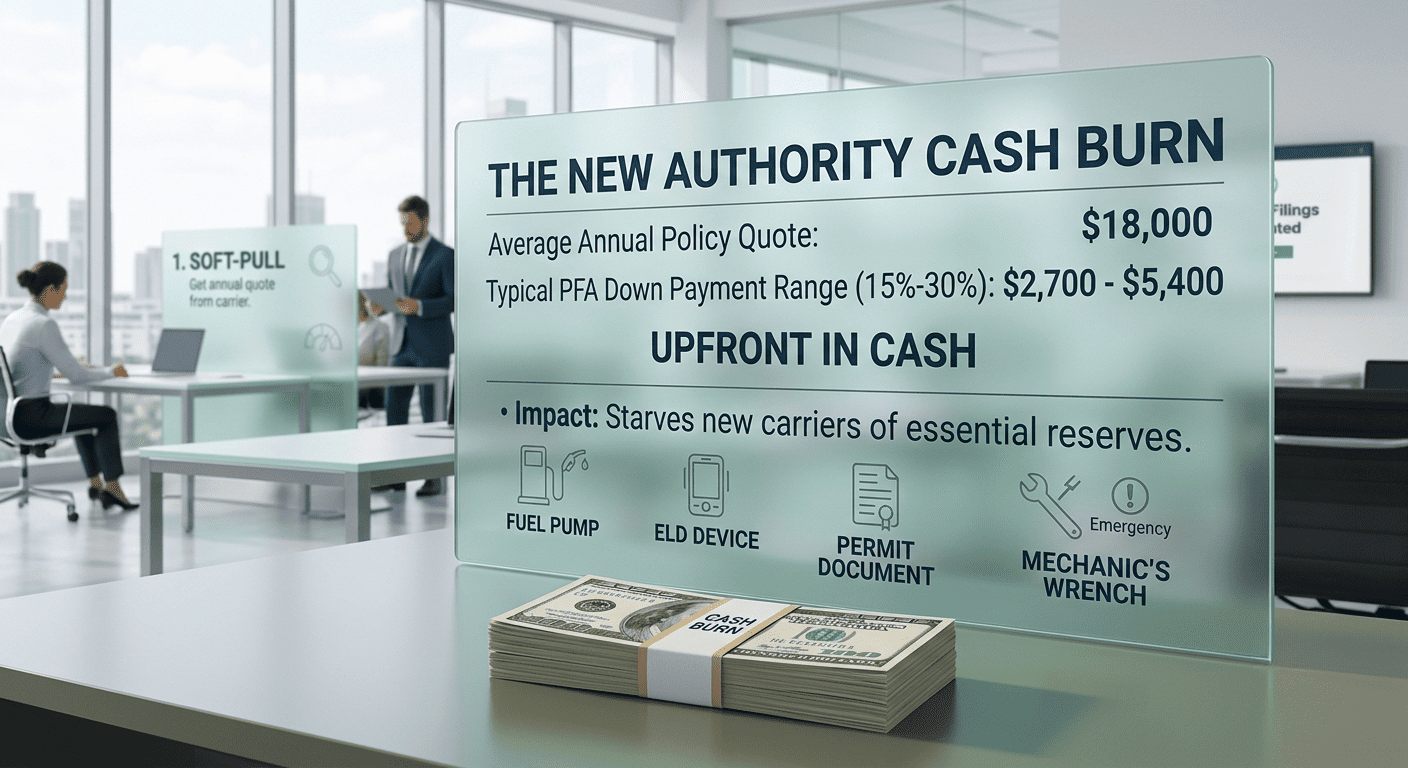
Because new authorities carry a higher statistical risk during their first 12 months, premium finance companies (PFCs) mandate a 15% to 30% upfront cash deposit. On an $18,000 annual policy, you are forced to hand over $2,700 to $5,400 in cash upfront before your rig pulls its first load.
Draining your bank account to pay an insurance down payment leaves your operation dangerously vulnerable. Without liquid cash reserves, a single delayed invoice, fuel spike, or minor repair can derail your business before it gets off the ground.
How a Premium Finance Agreement (PFA) Works in Trucking
Unless you have the capital to pay your entire annual policy in one lump sum, you will utilize a Premium Finance Agreement (PFA). A PFA is a specialized short-term loan that covers the remaining 70% to 85% of your annual insurance premium after your down payment is made.
1. The Collateral Model: How Unearned Premiums Secure the Loan
Unlike an equipment loan that uses your truck title as collateral, a PFA is secured by the unearned premium of the insurance policy itself. If you borrow $15,000 to cover your policy and cancel it six months later, the insurance carrier refunds the remaining unused cash balance directly to the finance company to settle the loan. Because the loan is backed by the policy’s unearned funds, lenders can approve PFAs quickly without requiring heavy physical collateral.
2. Standard 9–10 Month Installment Schedules
PFAs spread your remaining insurance balance across 9 or 10 monthly payments. This means even though your policy covers 12 months, your loan is paid off two to three months early, giving the lender a risk safety buffer.
Operational Warning: When you sign a PFA, you grant the finance company a limited Power of Attorney (POA). If you miss a monthly payment by even 5 to 10 days, the finance company has the legal authority to request an immediate policy cancellation from your insurance carrier. This automatically triggers an FMCSA notification, revoking your active authority filings (BMC-91) and grounding your fleet.
Strategic Solutions for Down Payment Help on Truck Insurance
If paying a 25% insurance down payment threatens to drain your startup cash reserves, you don’t have to carry the burden entirely out-of-pocket. Successful carriers often stack capital solutions to protect their liquidity:
- Combining Working Capital with Long-Term Equipment Loans: By structuring your rig purchase through flexible commercial truck and trailer financing, you can keep more liquid cash in your business checking account specifically allocated for insurance deposits and fuel.
- Leveraging Existing Vehicle Equity: If you own an existing truck, trailer, or vocational unit with equity, unlocking working capital from existing vehicle equity via cash-out refinancing can provide the exact lump sum needed to cover your initial 20%–30% insurance deposit.
- Revolving Working Capital Lines: Securing a revolving line of credit or factoring solution gives you a safety cushion to absorb monthly PFA payments during 30- to 60-day shipper payment cycles.
The Step-by-Step Semi Truck Insurance Premium Finance Process
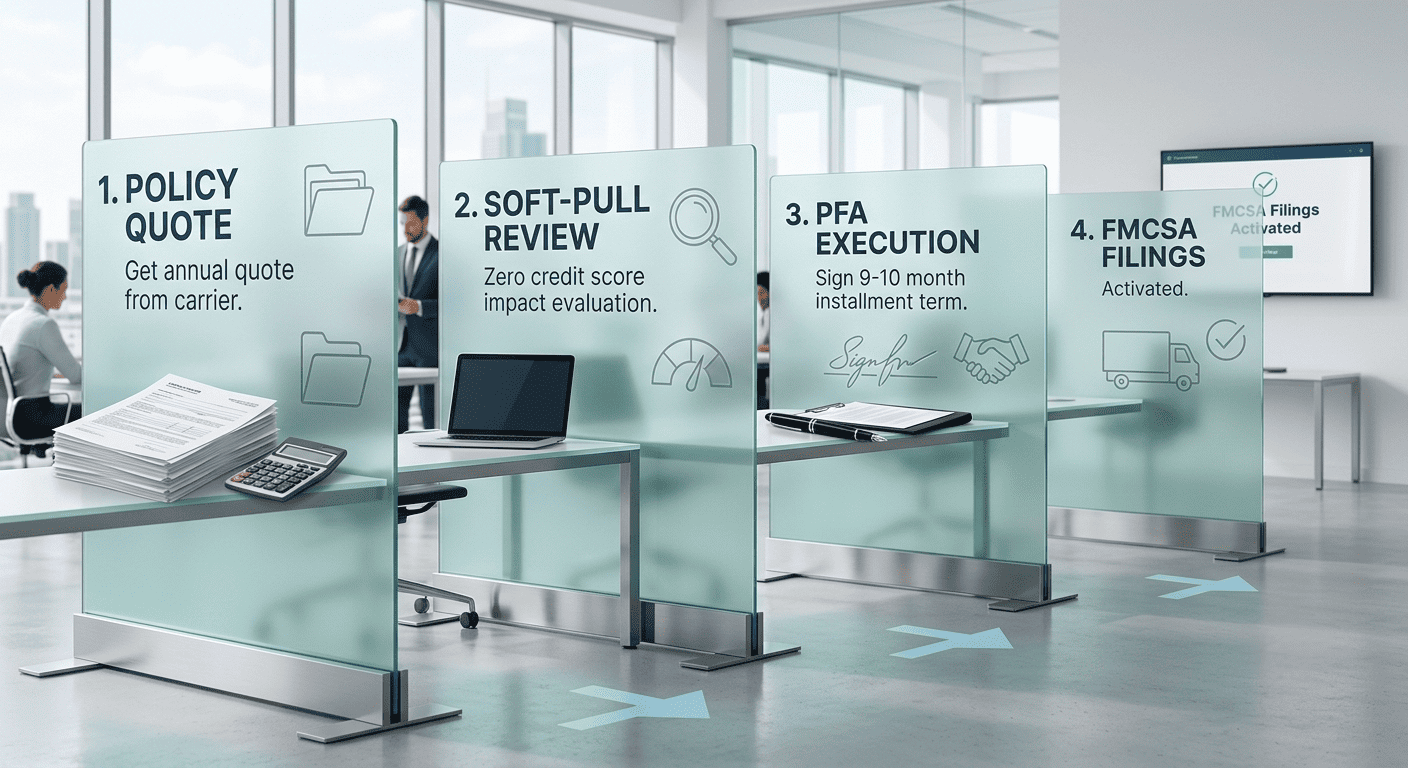
Policy Quote Review: Your insurance agent presents an annual policy quote along with the required down payment percentage.
Soft-Pull Credit Evaluation: The premium finance company conducts an initial review. At Lewis Capital, we prioritize a soft credit check that will not impact your credit score, allowing us to evaluate your overall business capital options safely.
PFA Execution: You sign the finance agreement, pay the initial down payment deposit, and set up your monthly installment schedule.
Active FMCSA Filings: Once the down payment and signed PFA are processed, your insurance provider submits your BMC-91 or Form 34 filings to the FMCSA, bringing your authority from “Pending” to Active.
How Lewis Capital Helps New Motor Carriers Build Cash Flow Stability
At Lewis Capital, we know that getting approved for a truck is only half the battle, keeping your business funded and operational is what drives long-term success. With over 25 years of hands-on commercial lending experience, we don’t rely on cold automated algorithms to make decisions. We talk with you directly to understand your business goals, your routes, and your capital needs.
Whether you need to lower your equipment down payment to save cash for insurance, or explore a working capital line to smooth out monthly overhead, our team is here to help you navigate the process with clarity and speed.
Get pre-qualified for commercial financing today, our initial review uses a soft credit check with zero impact on your credit score.
Frequently Asked Questions
Can a new motor carrier get insurance with $0 down?
No. New authorities lack an established safety track record, so insurers require a 15% to 30% down payment upfront.
What happens if I miss an insurance loan payment?
Your policy can be canceled within 5–10 days. The insurer then notifies the FMCSA, which revokes your active authority and grounds your trucks.
Will applying for insurance financing hurt my credit score?
No. Pre-qualification uses a soft credit check that leaves no footprint on your credit score.
Can I use a working capital loan or factoring for the down payment?
Yes. Many new carriers use working capital lines or equipment equity to cover the initial cash deposit and preserve daily liquidity.
Why are insurance loans paid over 9–10 months instead of 12?
Financing over 9 or 10 months ensures the remaining policy value always stays higher than your unpaid balance, protecting the loan.