
How to Get a Commercial Truck Loan for a Private Party or Auction Sale
Buying a semi truck from a private seller or an auction like Ritchie Bros. or IronPlanet can save you 15% to 30% compared to retail dealership prices. However, traditional retail banks often reject these deals because they lack dealer warranties, require complex title/lien verification, or cannot meet strict 24-to-72-hour auction payment deadlines.
Specialized direct lenders evaluate your operational cash flow and credit strength to issue pre-approval letters before you bid or buy. Once you win an auction or reach a deal with a private owner, the lender handles lien payoffs and wires funds directly to the seller within 24 to 48 hours.
Why Buyers Are Skipping Dealerships
Securing quality commercial equipment is one of the largest capital expenditures an owner-operator or fleet manager makes. Over the past few years, smart buyers have shifted away from commercial truck dealerships toward private sellers and commercial auctions.
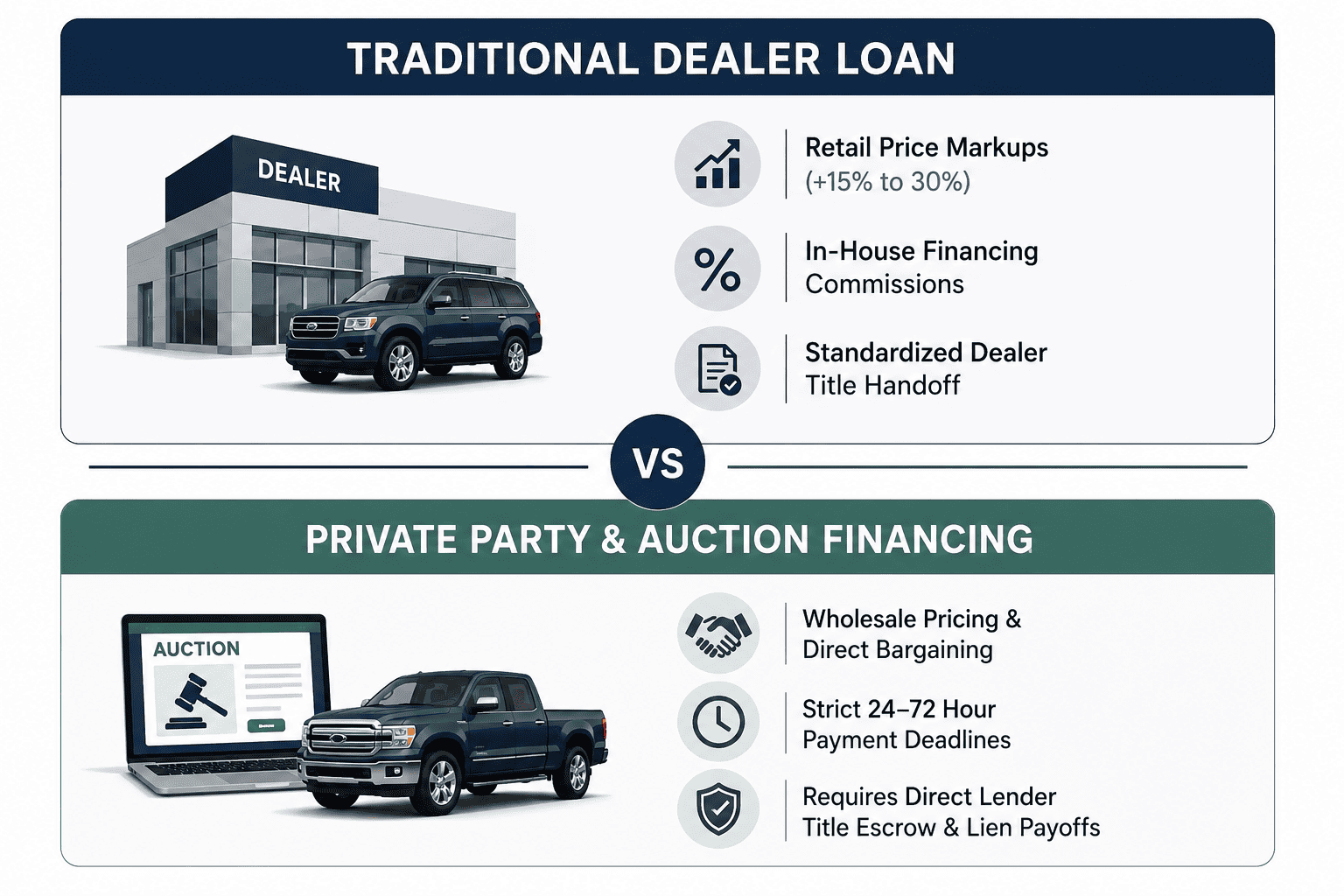
Commercial truck dealerships add substantial overhead markups to cover warranty reserves, facility maintenance, and sales commissions. Purchasing directly from a private seller or winning a lot at an auction allows you to stretch your equipment budget significantly further.
However, traditional banks and credit unions are built for standard dealership transactions. When you present a bank with a private seller listing or an auction lot, you face three primary obstacles:
- Strict Payment Deadlines: Commercial auctions typically demand full settlement within 24 to 72 hours of the final hammer drop. Traditional bank underwriting routinely takes 2 to 3 weeks.
- Title and Lien Vulnerability: Private sellers may still have an active lien on the truck. Retail banks rarely have dedicated teams to coordinate direct payoff verification with third-party lenders.
- Lack of Inspection Warranties: Vehicles sold “As-Is, Where-Is” represent higher perceived risk for lenders who rely strictly on standardized dealer inspection checklists.
Overcoming these hurdles requires working with a direct commercial equipment lender that specializes in private seller transactions.
Core Underwriting Rules for Private Seller Semi Truck Loan Approval
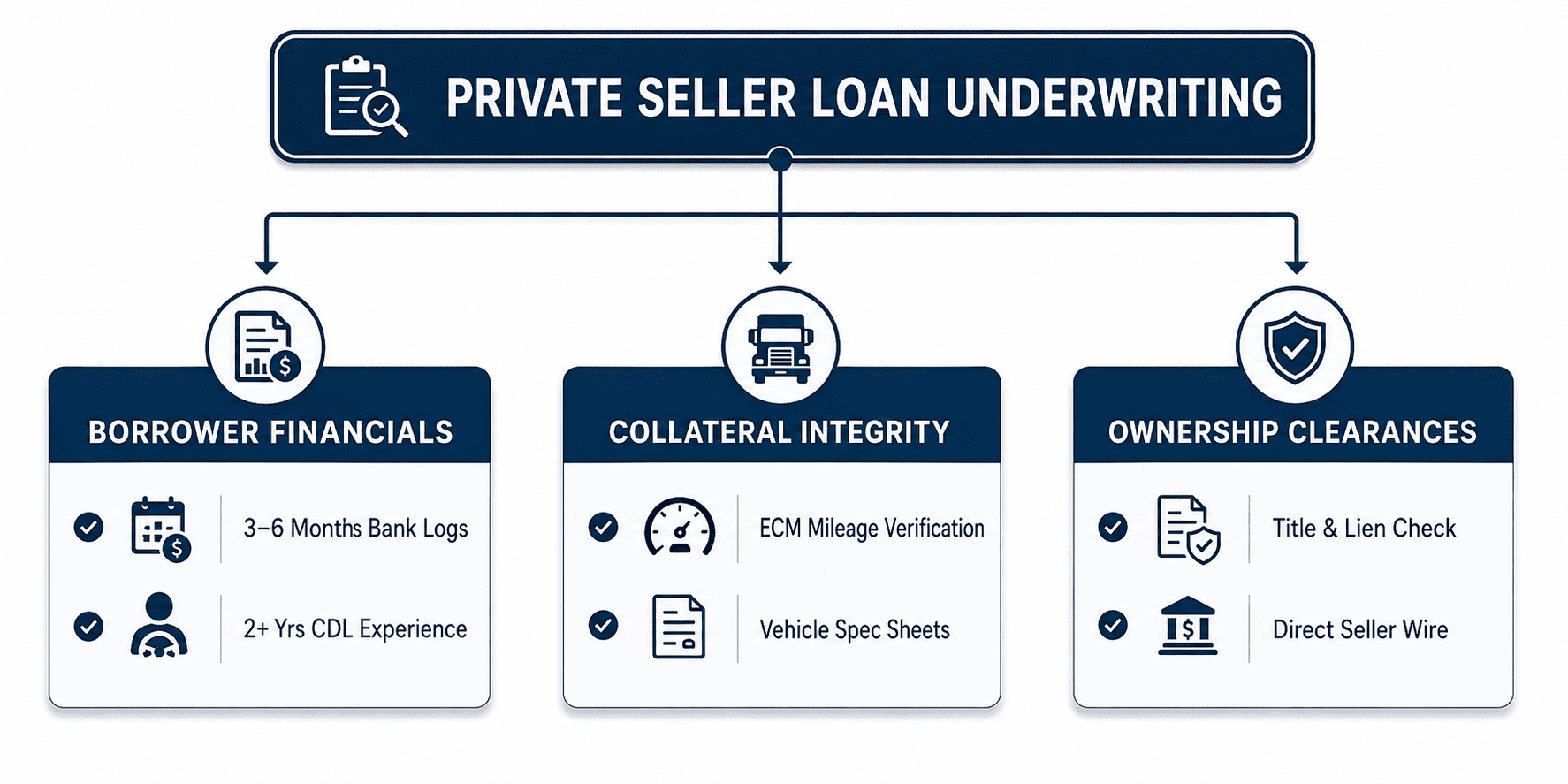
Securing a private seller semi truck loan approval requires a clear understanding of what commercial credit committees evaluate. Underwriters analyze three distinct pillars during their review.
Borrower Credit Profile & Industry Experience
Underwriters look at your personal FICO score alongside your overall operational history. Prime borrowers (700+ FICO) enjoy minimal down payment options and competitive rates. However, if your credit history has past setbacks, options like bad credit truck financing evaluate real bank cash flow rather than judging your business solely on a credit score. Holding a valid Class A Commercial Driver’s License (CDL) for at least 2 years serves as a critical compensating factor.
Vehicle Valuation & Mechanical Inspection
Because private sales do not include a dealer guarantee, lenders verify collateral value through Engine Control Module (ECM) readouts, vehicle spec sheets, and high-resolution photos. The ECM report cross-references cluster mileage against total engine hours, active fault codes, and historical oil pressure levels to ensure the truck’s market value aligns with the requested loan amount.
Title Verification & Lien Payoff Protocols
Before any funds are released, underwriters run a clean title check to ensure the vehicle is free of salvage, rebuilt, or flood-damaged classifications. If the private seller still owes money on their existing loan, the lender contacts the seller’s financial institution to secure an official payoff statement, ensuring direct titling transfers upon settlement.
Faced a Prior Loan Denial?
If a traditional bank recently turned down your commercial truck loan application, you still have options. Read our step-by-step recovery guide: Got Rejected for a Semi-Truck Loan? Steps You Can Take Right Now to Still Get Approved to learn how cash-flow-based underwriting can get your approval back on track.
Comparing Private Party vs. Commercial Auction Financing
While both options allow you to purchase below retail cost, private party transactions and auction purchases operate under completely different underwriting timelines and compliance rules.
Underwriting Metric | Private Seller Purchases | Commercial Auction Purchases (Ritchie Bros, IronPlanet) |
Funding Window | Flexible (Typically 3 to 7 business days) | Immediate (Strict 24 to 72-hour window post-bid) |
Pre-Approval Need | Recommended prior to price negotiations | Mandatory prior to entering the bidding portal |
Title Clearance | Coordinated directly with seller or seller’s bank | Managed through auction house title department |
Vehicle Inspection | Independent mobile mechanic inspection encouraged | Buyer relies on auction condition reports & ECM data |
Seller Payment Method | Direct wire to seller’s bank or escrow account | Direct wire transfer to the auction house cashier |
The 3-Step Expedited Approval Process
Getting funded for a non-dealer semi truck purchase does not need to be complicated. Following a structured three-step process keeps your transaction moving forward smoothly.
Step 1: Secure Pre-Qualification Before Shopping
Never start bidding at an auction or negotiating with a private seller without pre-approval in hand. Submitting a initial credit application allows a direct lender to run a soft credit pull, which does not impact your FICO score. Once qualified, you receive a pre-approval letter establishing your maximum purchase budget and maximum loan-to-value (LTV) limits.
Step 2: Submit Vehicle Documentation & Title Information
Once you select a truck or win an auction lot, collect the necessary collateral documents from the seller or auction house:
- Bill of Sale or Invoice Draft: Outlining the agreed purchase price, VIN, year, make, and model.
- Seller Title Copy: Front and back copies of the clean title, or an official bank payoff letter if a lien exists.
- ECM & Photo Verification: Detailed photos of the VIN plate, odometer, engine bay, and hydraulic/boom assemblies (if financing vocational equipment).
Step 3: Direct Seller Wire & Escrow Settlement
Once the collateral documents are verified, loan agreements are signed electronically. To protect all parties, your lender wires the approved funds directly to the auction house cashier or to the seller’s lienholder to pay off the existing title balance. Any remaining funds are transferred directly to the seller, and the clean title is issued directly to your operating business.
Critical Red Flags That Can Stall Your Loan
Understanding common red flags enables you to filter out problematic deals before wasting time or money on earnest deposits.
Branded or Salvage Titles
Commercial lenders almost universally decline vehicles with salvage, rebuilt, junk, or lemon-law buyback titles. The structural integrity and future resale value of a branded commercial vehicle present unmanageable collateral risk. Always request a VIN history report before inspecting a private vehicle.
Uncleared Liens and Seller Escrow Refusal
If a private seller owes money on their rig but insists that you wire funds directly to their personal bank account before paying off their lender, stop the transaction. Reputable direct lenders always execute a simultaneous lien payoff directly with the title-holding bank to guarantee a clear title transfer.
Private Sellers Requesting Untraceable Payments
Legitimate commercial lenders only disburse loan funds via direct bank wire transfer or cashier’s check payable to the verified legal owner. Private sellers who demand physical cash or peer-to-peer digital transfers cannot clear commercial loan compliance checks.
Secure Private Party & Auction Funding with Lewis Capital
Finding a great deal on a private seller rig or winning a commercial auction lot should be an exciting step forward for your business, not a battle with bank bureaucracy.
With over 25 years of commercial lending expertise, Lewis Capital provides fast, flexible financing tailored to non-dealership purchases nationwide.
- Fast Funding: Clear decisions and wire disbursements in 24 to 48 hours.
- Zero Credit Risk to Start: Soft-pull pre-qualification with no impact on your FICO score.
- Flexible Approval Terms: Programs available for owner-operators, expanding fleets, and all credit profiles.
Get Pre-Qualified for Private Seller & Auction Truck Financing Today
Frequently Asked Questions
Can I get a commercial truck loan for a private party sale?
Yes. Direct commercial equipment lenders finance private party semi truck purchases. You will need a soft-pull pre-approval, 3 to 6 months of business bank statements, a valid Class A CDL, a draft Bill of Sale, and a copy of the seller’s clean title or lien payoff statement.
How fast can an auction truck loan get funded?
Commercial auction loans can be approved and funded within 24 to 48 hours. Because platforms like Ritchie Bros. and IronPlanet require full payment within 24 to 72 hours of winning a bid, securing a bank pre-approval letter before auction day is essential to meet strict settlement rules.
How does down payment work for private seller semi truck loans?
Down payments for private party semi truck loans typically range from 10% to 20% for prime credit borrowers (700+ FICO). Buyers with near-prime or subprime credit, or those purchasing older high-mileage units, may be required to put down 20% to 30% to cover collateral risk.
What happens if the private seller still owes money on the truck?
If the seller has an active loan, your direct lender coordinates a simultaneous lien payoff. The lender wires the exact payoff amount to the seller’s financial institution to release the title, and any remaining balance is paid directly to the private seller.
Looking to Keep Your Cash Reserves Intact?
Buyers purchasing pre-owned rigs often want to minimize upfront cash requirements. Explore our guide on What Are the Requirements for Zero-Down Semi-Truck Financing? to see if your credit profile and time in business qualify you for 100% equipment funding.