
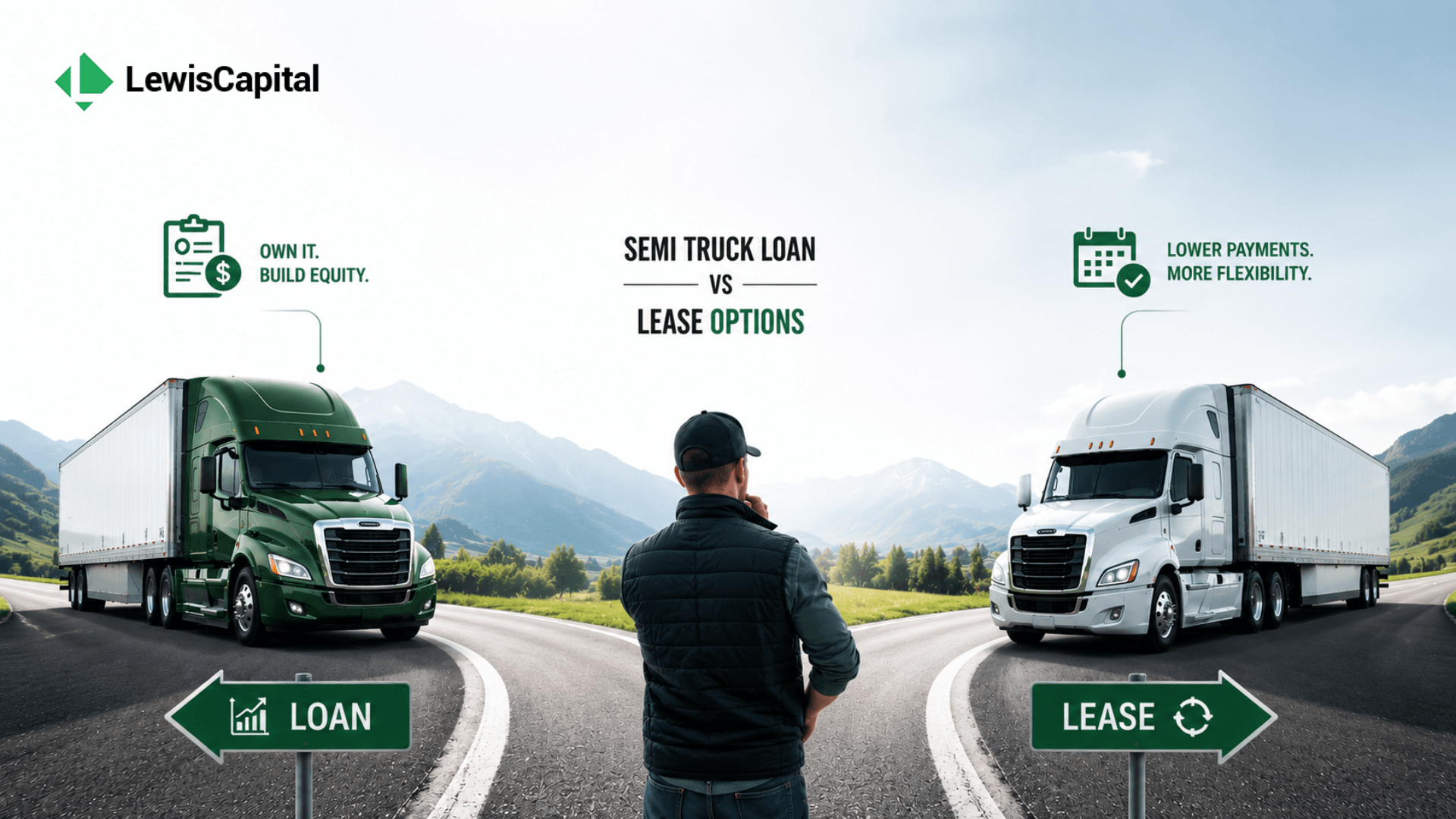
Semi Truck Loan vs Lease: Which Is Better for Owner-Operators in 2026
Financing your semi truck is one of the biggest financial decisions you’ll make as an owner-operator. Get it right, and you’re building toward long-term wealth. Get it wrong, and you’re locked into payments that squeeze your margins every single month.
In 2026, with commercial financing rates higher than during the low-rate era and freight rates showing mixed signals, this decision carries more weight than ever. This guide cuts through the noise and gives you a straightforward comparison between semi-truck loan and lease options so you can choose the best fit option for your business.
Semi-Truck Loan vs. Lease: How Each Option Works
Semi Truck Loan (Financing)
With a loan, a lender fronts the purchase price of the truck. You make fixed monthly payments, typically over 36 to 84 months, and you own the truck outright when the loan is paid off. Expect a down payment of 10 to 20%, though some lenders offer lower entry points depending on your credit profile. Lenders range from traditional banks and credit unions to SBA-backed programs and specialized commercial truck lenders like Lewis Capital.
Semi Truck Lease
A lease lets you use a truck without buying it. You make lower monthly payments for a set term, then either return the truck or purchase it at a residual value. There are two main types: an operating lease, where the truck stays off your balance sheet and payments are fully deductible; and a finance (capital) lease, which functions more like ownership for tax and accounting purposes.
One important note: a lease-to-own agreement is not a traditional lease. It’s structured as a rent-to-purchase arrangement; you’re building toward ownership, but you don’t hold the title until the buyout is complete.
True Cost Comparison: Why Total Cost Matters More Than Monthly Payment
Let’s put real numbers on this. Assume a $150,000 new semi truck in 2026.
With a loan at current commercial rates, your monthly payment will be higher, but your total cost over the term is lower, and you walk away owning a tangible asset. With a lease, you’ll enjoy smaller monthly payments and lower upfront costs, but over the full term, you’ll typically pay more and have nothing to show for it unless you exercise a buyout option.
Factor | Loan | Lease |
Monthly Payment | Higher | Lower |
Down Payment | 10-20% | 0-5% |
Total Cost Over Term | Lower | Higher |
Mileage Cap | None | Often Yes |
Ownership at End | Yes | No (unless buyout) |
Figures vary based on lease terms, buyout options, and truck depreciation. Always calculate the total cost before signing.
How to Turn Your Financing Choice Into a Tax Advantage
Your owner-operator truck financing choice has a direct impact on what you owe at tax time, and this alone can flip the math in one direction.
With a Loan - You Can Unlock Section 179 Benefits:
The truck is yours, which means you can take advantage of Section 179 expensing to deduct part or all of the purchase price in the year the truck is placed in service, depending on your business income and current IRS limits. In some cases, bonus depreciation may also apply. You may also be able to deduct the interest on the loan as a business expense, while continuing to build equity in an asset you own.
With a Lease - You Get Simpler Accounting But Less Tax Firepower:
Operating lease payments are fully deductible as a business operating expense: straightforward and clean. There’s no depreciation schedule to manage, which significantly simplifies your accounting. A finance lease, however, is treated by the IRS more like ownership, so its tax treatment more closely mirrors a loan.
Important note: Tax strategy alone can completely change which option wins. Before you sign anything, talk to a CPA who specializes in owner-operator trucking businesses.
Who Qualifies and When: Credit, Cash Flow, and the Approval
Semi truck loans start at 650, but stronger terms typically require 680 or higher, along with a demonstrated business history. Newer owner-operators can still qualify, especially with a strong down payment or collateral, but expect more scrutiny from traditional lenders. Lewis Capital works with a wide range of credit profiles and understands the realities of trucking income.
On the other hand, semi-truck leases are often more accessible for first-time operators with limited credit history or limited upfront capital, since the barrier to entry is lower and down payments are minimal.
The more important question is this: can your cash flow handle a higher monthly loan payment without cutting into your operating reserves? If you’re running tight routes or navigating a slow freight season, a lower lease payment can be the difference between staying afloat and falling behind.
Seasonal operators and those building their client base often benefit from the breathing room a lease provides, at least in the early years. Just go in with eyes open about the total cost.
Ownership, Flexibility & the Carrier Lease Warning
With a Loan, you own your operation fully.
You can haul any load, on any lane, for any broker or shipper. You build equity in a depreciating asset that still holds real resale value. When the truck is paid off, your operating costs drop significantly. This model works best for established operators with reliable freight contracts and the credit to qualify.
With a Lease, you gain flexibility but with trade-offs.
The lower barrier to entry makes leasing attractive for new operators. And as emissions regulations and EV mandates continue to evolve post-2026, leasing makes it easier to transition to a compliant truck without the financial pain of selling a depreciating owned asset. Some lessors also bundle in maintenance programs, which reduces surprise repair costs.
How Carrier-Sponsored Leases Deserve a Serious Warning
Some trucking companies offer lease programs that seem like a deal but come with strings attached that can trap you financially.
Red flags to watch for:
- High per-mile deductions that eat into your gross revenue
- No guaranteed minimum loads: you’re dependent on the carrier’s dispatch
- Excessive chargebacks for fuel, insurance, tolls, and administrative fees that quietly drain your take-home pay
If you’re considering a carrier-sponsored lease, read every line of the agreement and have someone experienced review it before you sign.
Semi-Truck Loan or Lease: Which Is Right for You?
Here’s a straightforward decision guide based on your situation:
Choose a Semi-Truck Loan if:
- Your credit score is 680+
- You have steady freight contracts or consistent revenue
- You plan to operate the truck for 5 or more years
- You want to take advantage of Section 179 tax benefits
- Building long-term equity matters to your financial plan
Choose a Lease if:
- You’re just starting with limited capital or credit history
- You need a lower or no-money-down semi-truck to protect your working capital
- You expect to upgrade your truck within three years
- You prefer simpler accounting without managing depreciation
- You want the flexibility to adapt to evolving emissions standards
Proceed with caution if:
- A carrier lease requires you to haul exclusively for them, with no guaranteed load minimum
- The lease mileage cap falls below your average annual mileage, and the overage fees will add up fast
The Decision is About Your Business, Not Just the Truck
After the whole discussion, it is crystal clear that the loan vs. lease decision comes down to one thing: what fits your credit, cash flow, and long-term goals. Loans build equity; leases preserve cash. Both work when chosen deliberately.
At Lewis Capital, we specialize in commercial truck financing for owner-operators at every stage of their business. We understand your business model, structure deals around your operation, and help you move fast, whether it’s your first truck or your fifth.
Ready to move forward? Contact Lewis Capital today for the best semi-truck financing or leasing option.
Frequently Asked Questions
Can I write off my truck payments on my taxes regardless of whether I lease or finance?
Yes, but differently. Loan interest and depreciation are deductible when you finance. With an operating lease, the full monthly payment is deductible as a business expense. A trucking CPA can help you determine which approach saves you more at tax time.
What happens if I exceed the mileage limit on a semi truck lease?
You’ll owe overage fees, typically charged per mile above the cap. These costs add up quickly for high-mileage operators and can significantly increase your total lease cost. Always compare your average annual mileage against the lease cap before signing.
Does Lewis Capital work with owner-operators who have bad credit or no business history?
Yes. Lewis Capital works with a wide range of credit profiles and understands that trucking income doesn’t always look conventional on paper. We evaluate your full financial picture, not just your credit score, to find workable financing solutions.
Should I lease or finance if I plan to upgrade my truck every few years?
Leasing makes more sense if you upgrade frequently. It avoids the hassle of selling a depreciating asset and lets you transition to newer, cleaner trucks more easily, especially important as emissions regulations continue tightening through 2026 and beyond.
What is the biggest mistake owner-operators make when choosing between a loan and a lease?
Focusing only on the monthly payment. A lower lease payment can look attractive, but it often costs more over the full term. Always calculate the total cost of ownership, including fees, mileage penalties, and buyout options, before making your final decision.