
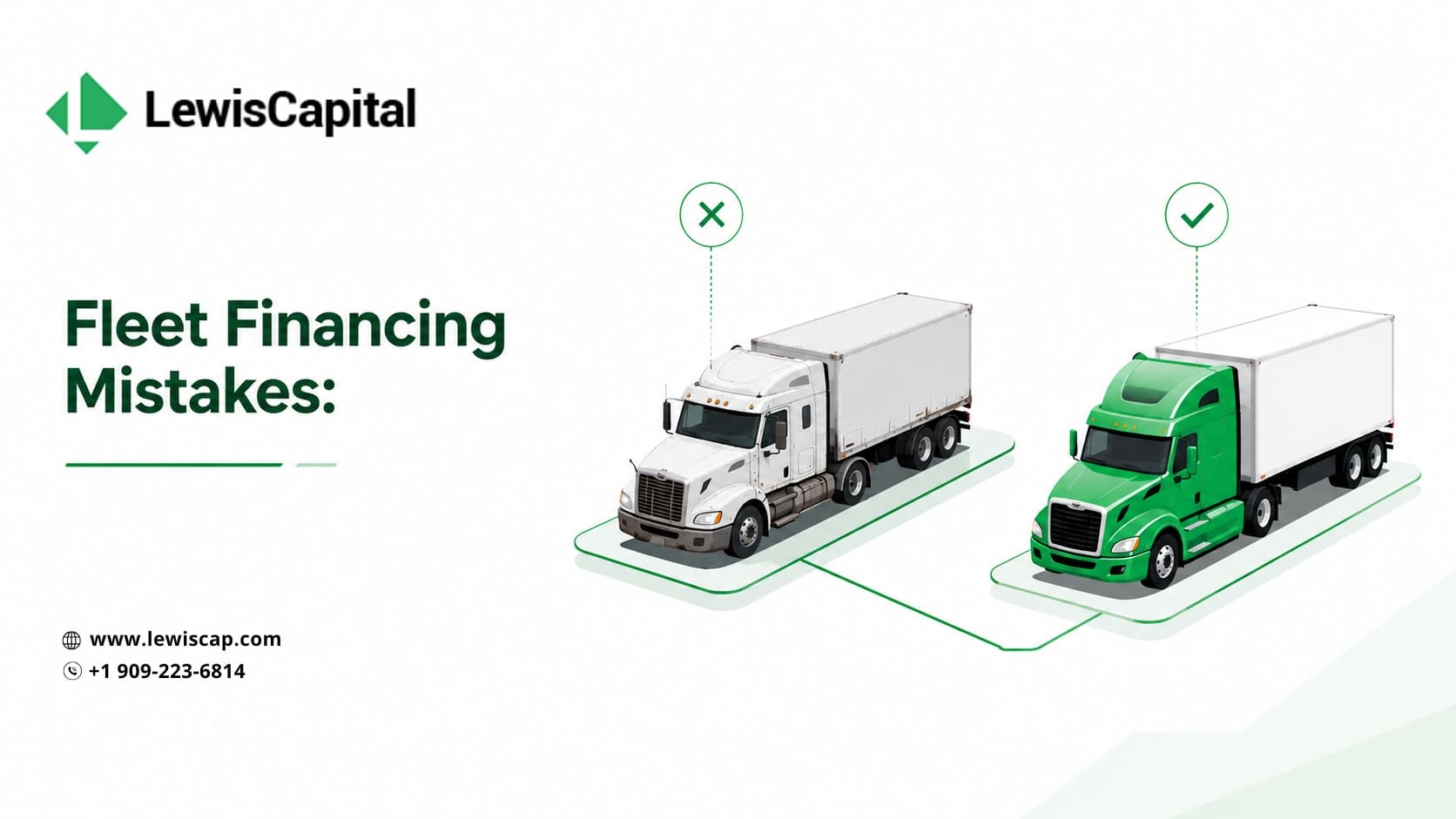
Fleet Financing Mistakes: Why Used Trucks Hurt Your Trucking Business Profits
When your margins are tight, and your operating costs keep climbing, the vehicles in your fleet are either working for your bottom line or quietly draining it. For many owner-operators and fleet managers, the biggest financial mistake they make is not the loan they take out, but the truck they choose to finance.
Understanding how fleet financing decisions impact long-term profitability is one of the most overlooked aspects of trucking business financing. This guide breaks down the most costly mistakes trucking businesses make when financing older trucks, and what smarter financing choices can do for your profits.
The Hidden Cost of Running Older Trucks in Your Fleet
On the surface, financing an older truck seems like the affordable choice. The purchase price is lower, and the monthly payments look manageable. But the true cost of an aging vehicle often shows up where you least expect it, in your repair bills, at the fuel pump, and in your insurance premiums.
The Hidden Cost of Running Older Trucks in Your Fleet
A truck that is more than ten years old or has crossed the 500,000-mile mark is statistically far more likely to require frequent and expensive repairs. Engine overhauls, transmission replacements, brake system failures, and electrical issues become increasingly common as vehicles age. According to industry estimates, a single major breakdown can cost a trucking business between $5,000 and $20,000 in parts, labor, and lost revenue from downtime.
When you finance a used truck, you are not just paying for the vehicle; you are also absorbing all the maintenance risk that comes with it. Those unexpected repair costs hit hardest when you are already managing a loan payment on top of fuel, insurance, and driver wages.
Lower Fuel Efficiency = Higher Operating Costs
Fuel is one of the single largest operating expenses in any trucking business, accounting for roughly 25-35% of total costs. Older trucks, particularly those manufactured before more efficient engine standards were introduced, consume significantly more diesel per mile than newer models.
A newer Class 8 truck can achieve 7-8 miles per gallon, while an older model may only deliver 5-6 miles per gallon. Across thousands of miles driven each month, that difference adds up to thousands of dollars in avoidable fuel costs every year, costs that directly eat into your profit margin on every load.
Common Fleet Financing Mistakes Trucking Businesses Make
Poor fleet financing decisions rarely feel like mistakes at the time. They often look like the smart, budget-conscious move. Here are the most common errors that end up costing trucking businesses far more in the long run.
Financing a Truck That Costs More to Run Than to Replace
This is the most widespread fleet financing mistake in the industry. A trucking business takes out a loan on a high-mileage vehicle because the upfront cost is low, then spends the next 24 to 36 months absorbing constant repair costs that far exceed what a new or newer-model truck loan would have cost monthly.
Before committing to any financing on a used vehicle, always calculate the total cost of ownership, not just the purchase price. Factor in projected maintenance, fuel consumption, insurance, and depreciation before signing any loan agreement.
Over-Leveraging on Multiple Aging Assets
Fleet owners building out multiple trucks sometimes fall into the trap of financing several older vehicles simultaneously to keep individual loan amounts low. The result is a fleet full of high-maintenance trucks, each carrying its own loan payment, and a business stretched thin trying to service debt on assets that are all depreciating rapidly at the same time.
Smart trucking business financing means thinking about your entire fleet’s financial health, not just the cost of a single vehicle in isolation.
Choosing Short-Term Savings Over Long-Term ROI
Financing a $45,000 used truck instead of a $120,000 newer model feels like the responsible financial decision. But if that older truck costs an additional $15,000 per year in maintenance and burns 20% more fuel, the newer truck often pays for the difference within two to three years, and keeps paying dividends long after.
A strong fleet financing strategy means evaluating the return on investment over the life of the loan, not just the size of the monthly payment.
Ignoring Depreciation When Calculating Loan Value
Older trucks depreciate faster and more unpredictably than newer ones. If you finance a high-mileage truck and it suffers a major mechanical failure 18 months into the loan, you may find yourself in a position where you owe more on the vehicle than it is worth, commonly known as being “upside down” on your loan. This limits your ability to trade, sell, or refinance, and traps your capital in a depreciating, underperforming asset.
Thinking about upgrading your fleet? Lewis Capital offers fast, flexible commercial truck financing for all credit types. Check your options here.
When Does It Make Sense to Finance a Used Truck?
Used truck financing is not always the wrong choice. There are situations where it makes solid financial sense, but only when you approach it with the right criteria in mind.
Age and Mileage Thresholds to Watch
As a general rule of thumb, a used semi-truck financing is still a reasonable financing candidate when:
- It is no more than 5 to 7 years old
- It has fewer than 400,000 to 500,000 miles on the engine
- It has a full, documented maintenance and service history
- It has passed a pre-purchase inspection by a certified diesel mechanic
Trucks that fall outside these thresholds carry significantly elevated financial risk and should be approached with extreme caution when considering financing.
How to Evaluate a Used Truck Before Financing
Before signing any loan agreement on a used vehicle, run through this checklist:
- Pull a full vehicle history report (CARFAX or similar)
- Verify the engine type and whether it has been rebuilt or replaced
- Check for any active recalls or compliance issues with FMCSA regulations
- Get an independent mechanic’s inspection, not just a dealer inspection
- Calculate total projected operating costs for the next 36 months
If the numbers do not work on paper, they will not work on the road.
How Upgrading Your Fleet Can Improve Profitability
Investing in newer equipment through smart fleet financing is not just about avoiding repair costs. It directly improves your ability to win better-paying loads, lower your operational expenses, and build a more sustainable business.
Newer Trucks, Better Fuel Economy, Lower Insurance Premiums
Modern semi-trucks come equipped with advanced aerodynamics, fuel-efficient powertrains, and safety technology that older vehicles simply cannot match. The commercial truck financing trends in 2026 reflect just how quickly the industry is moving toward smarter, more fuel-efficient fleet investments.
Additionally, insurance companies typically offer lower premiums for newer vehicles because they pose less mechanical risk and are equipped with modern safety features such as automatic emergency braking and lane-departure warnings.
How Commercial Truck Financing Makes Upgrades Affordable
Many trucking business owners assume that upgrading to a newer vehicle is financially out of reach. The reality is that structured commercial truck financing makes newer equipment highly accessible, even for businesses with challenged credit or limited operating history. Monthly payments on a newer truck are often comparable to, or only marginally higher than, payments on an older vehicle, especially when you account for the reduced fuel and maintenance costs that come with the upgrade.
The key is working with a lender who specializes in trucking business financing and understands the industry’s real-world economics.
How Lewis Capital Helps You Finance Smarter
Avoiding fleet financing mistakes starts with the right lending partner, one that understands the trucking industry well enough to guide you toward equipment that actually works for your business, not against it.
At Lewis Capital, we go beyond simply approving loans. We specialize in commercial truck and fleet financing for owner-operators and fleet managers who are serious about protecting their margins and making financing decisions that stand the test of time.
Whether you are looking to replace an aging truck that has been draining your repair budget, add a newer unit to your growing fleet, or restructure how you fund your operations, we offer the right tools to move forward confidently.
Stop letting an aging fleet quietly eat into your profits. Apply through our simple credit application and take the first step toward a fleet that works harder for your bottom line.