
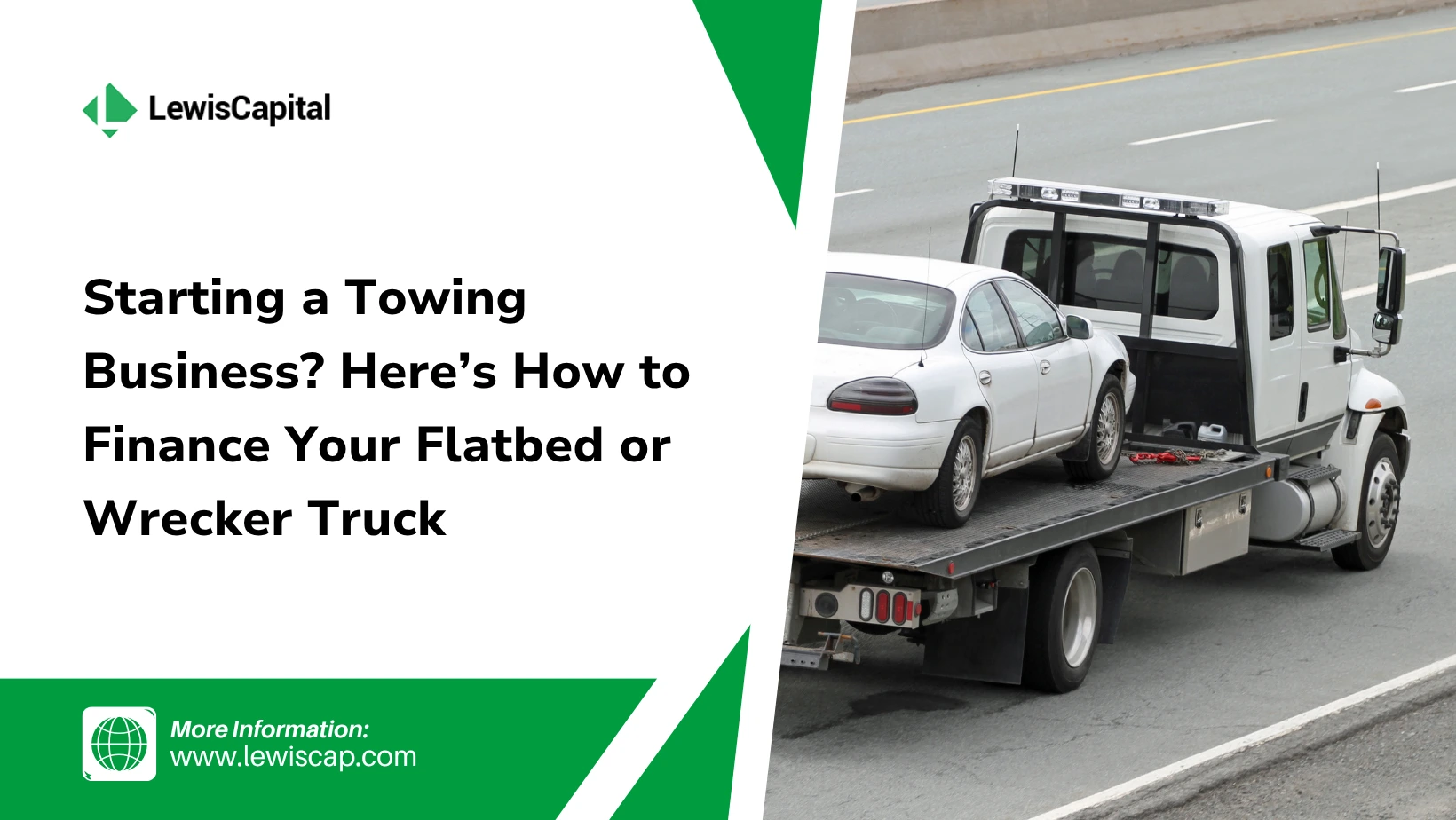
Starting a Towing Business? Here’s How to Finance Your Flatbed or Wrecker Truck
Whether you are buying your first flatbed or expanding your fleet with a heavy-duty rotator, financing a tow truck comes with its own specific set of rules. Because towing equipment works harder and depreciates differently than standard over-the-road sleepers, underwriters scrutinize these loans closely.
Securing a commercial equipment loan for a wrecker requires more than just a decent credit score. To get approval, you need to present a file that proves the truck will generate reliable cash flow. Here is exactly how underwriters evaluate tow truck financing, what equipment clears underwriting fastest, and how to structure your deal for a quick approval.
The Revenue Model: How You Tow Dictates Your Loan
In the towing industry, underwriters care deeply about how your truck will make money. The risk profile of a repo agent is vastly different from that of a company doing municipal accident clearing. When you apply, the lender is looking to see which of these three revenue buckets you fall into:
Motor Club (AAA) and Cash Calls:
This is the most common model for light-duty flatbeds. While it proves steady demand, underwriters know the margins from motor clubs can be incredibly tight. To offset this, they will look heavily at your personal credit score and time in the industry. If you’re financing a light-duty flatbed for towing work, understanding your flatbed truck financing options can help you plan for the equipment cost and cash flow requirements.
Police Rotations and Municipal Contracts:
This is rocket fuel for tow truck loans. If you have an award letter or an active contract for city accident clearing or abandoned vehicle removal, lenders view your deal as highly stable. The predictable, higher-margin revenue makes it much easier to approve buyers with slightly bruised credit or a smaller down payment.
Repossession (Asset Recovery):
Repo work is highly lucrative, but traditional lenders often view it as high risk due to associated liability and the potential for equipment damage. If you are financing a wheel-lift specifically for repo work, expect lenders to ask for proof of a dedicated contract with a bank, auction house, or forwarder, along with a spotless driving record.
The Collateral Tiers: Matching the Iron to the Loan
Not all tow trucks are treated equally on a lender’s balance sheet. The type of equipment you buy directly affects your required down payment and interest rate.
Light-Duty Rollbacks (10,000–14,000 lb GVWR)
These are the easiest units to finance. A standard Ford F-550 or Ram 5500 chassis fitted with a Chevron, Jerr-Dan, or Vulcan aluminum carrier has a massive secondary market. Because lenders know they can easily liquidate a standard flatbed if a borrower defaults, they are more willing to offer favorable terms, lower down payments (often 10% to 15% for strong credit), and approve younger businesses.
Medium and Heavy-Duty Wreckers (26,000+ lb GVWR)
When you move up to tandem-axle wreckers and 50-ton rotators built for commercial recovery, the financing gets stricter. A heavy-duty Century rotator can easily cost upwards of $300,000 to $500,000+. For these deals, lenders usually require established business history (2+ years), pristine corporate financials, and proof that your market actually has the commercial traffic to support a note that size.
Get a Custom Tow Truck Financing Quote
Stop guessing about your approval odds. At Lewis Capital, we specialize in vocational equipment and understand the towing industry inside and out. Whether you are buying a used rollback or a new wrecker, our team provides clear terms and 24-48 hour approvals.
See Your Options for Tow Truck Financing– No Hard Credit Pull
The Hidden Underwriting Hurdle: Commercial Towing Insurance
Here is an industry reality that generic financing guides completely ignore: towing insurance can kill your truck deal before the lender even looks at it.
Underwriters know that commercial auto liability and on-hook coverage for tow trucks have skyrocketed. If you are a new business or a driver with a spotty MVR, your insurance premium could easily rival your actual truck payment.
Before a lender finalizes your funding, they require a certificate of insurance. If you wait until you are approved for the loan to shop for insurance, you might find that the premium chokes your cash flow, rendering the loan unworkable.
The Pro Move: Get your insurance quoted before you finalize your tow truck loan application. Showing an underwriter that you have already factored a $15,000 to $20,000 annual insurance premium into your operating budget proves you are a sophisticated operator, which dramatically strengthens your file.
Credit and Down Payment Realities for Tow Trucks
While the truck and the revenue model are critical, the hard numbers still apply. For tow truck financing, here is the current landscape:
- The Prime Tier (680+ FICO): Borrowers with clean credit, strong CDL experience, and clean bank statements can generally expect to put down 10% to 15%.
- The Mid-Tier (620–679 FICO): This is where most owner-operators sit. You are highly financeable, but the lender will scrutinize the truck’s age and mileage. Expect to put down 15% to 20%. Buying from a reputable commercial dealer rather than a private seller will greatly speed up this approval.
The Bruised Tier (Below 620): Traditional lenders will almost always pass. However, specialized alternative lenders can get these deals done if you have a larger down payment (often 25% to 30%+) and a truck with lower mileage and verifiable maintenance records on the PTO and hydraulics.
Why Traditional Lenders Overcomplicate Towing Loans
If you have ever been denied for wrecker truck financing by a local bank, it is rarely personal. Traditional lenders build their risk models around standard freight trucks. They see a 2017 Peterbilt with 350,000 miles and assume it’s nearing the end of its lifecycle, failing to realize that a well-maintained heavy-duty wrecker chassis can easily work profitably for another decade.
Furthermore, traditional lenders get spooked by the specialized nature of hydraulic systems, winches, and underlifts. They don’t want to underwrite equipment they don’t understand.
This is why partnering with Lewis Capital changes the equation. As a direct commercial lender, we know towing. We understand that a clean ECM read, a solid PTO, and a signed police rotation contract mean a lot more than just a FICO score. If you are tired of waiting weeks for a bank decision, learn how to get approved for truck loans in 24-72 hours.
Ready to Get Your Tow Truck on the Road?
Stop waiting on traditional lenders with a heap of requirements. Let Lewis Capital be your financing partner. Whether you are buying a used rollback or a 50-ton rotator, our team provides custom approvals in 24 to 48 hours.
Apply for tow truck financing today.
Prefer to talk through your deal? Call our vocational lending team directly at (909) 223-6814.
FAQs About Tow Truck Loans
Does it matter if I buy a tow truck from a private seller?
Yes. While you can finance a private-party tow truck, it takes longer and requires more scrutiny. Lenders prefer commercial dealers because they guarantee clean titles, clear VIN documentation, and generally inspect the hydraulics and PTOs before the sale. Private deals often require a rigorous third-party inspection before the lender releases funds.
Can I get a zero-down loan for a tow truck?
For the vast majority of buyers, the answer is no. Because tow trucks undergo heavy vocational wear and tear, lenders require equity in the equipment to mitigate risk. A 10% to 20% down payment is the industry standard for most used and new units.
Will a lender finance a repo truck?
Yes, but the underwriting is tighter. Because repossession work carries higher operational risks, lenders usually require a higher credit score, a solid down payment, and proof of experience in asset recovery before financing a sneak-lift or specialized wheel-lift truck.
Can I finance a used tow truck with high miles?
Yes, but the condition of the towing apparatus matters just as much as the engine. Lenders will want to ensure the winch, hydraulic pump, and boom are not severely worn. Typically, lenders prefer used tow trucks to be under 10 years old, though exceptions are made for well-maintained heavy-duty rotators.